A CHANGING PARKDALE
PIA BOUMAN
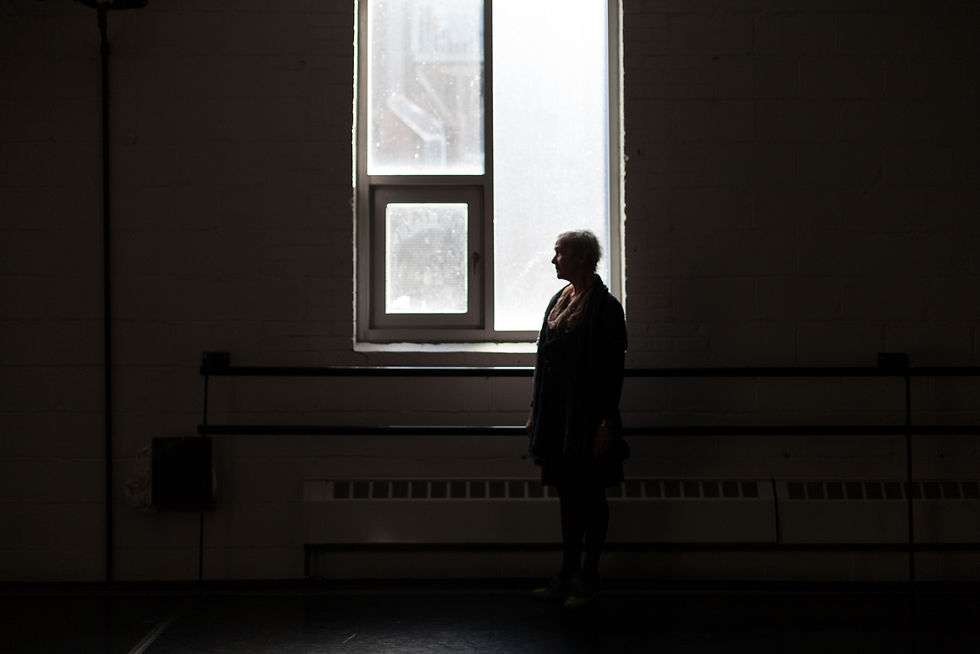
The Pia Bouman School for Ballet and Creative Movement has been a part of Parkdale’s cultural scene for almost forty years. In 2015, news came that its current home at 12 Noble St. had been bought by Sweeny & Co., a local architecture and development firm. Depending on how the re-development of the site proceeds, the school might be forced to close and move elsewhere. In early December 2016, Pia Bouman sat down to discuss her historic ties with the neighbourhood, as well as the school’s importance to the local economy and future prospects.
When did you know that you wanted to be a dancer?
PB: I was born with dance in my body. I only got my first lessons when I was probably twelve or thirteen years old, which is pretty old to start dancing. Dance has really been a guiding line running through my life. So I danced in Holland as part of my education. I pursued it as a career, before getting married. My husband and I didn’t want to stay in Holland, so we moved to Canada via the Philippines. And in Canada I had my two children, and then I said, “I really want to go back to dancing. I really need to do this for myself.”
So I started from scratch and i did my necessary dance exams. After I had been teaching for some time for somebody else in Thornhill, I started my own school in Parkdale.
I shopped around. I had a trial year on Roncy, and then the Church of the Epiphany, now the church of Our Lady of Lebanon [1515 Queen Street West] offered me their basement. My husband built a dance floor, and that was in 1979. I was also teaching at Montessori schools, so the first conscripts (if you can call them that) were boys and girls from the Montessori school on Parkside Drive. So from there, it evolved.
In the beginning people were scared to walk in, because there were usually five to ten prostitutes on the corners. Alcoholism was just above and beyond crazy. There was even a little bar that used to serve underage kids, so you had violent kids roaming at night. You had drugs being sold on the corner. It was pretty rough. A number of parents who wanted to give their child ballet classes, they would walk up and turn right back around, saying, “We can’t do this.”
When we decided to leave, twenty five years later, we paraded with the students and the parents down Queen street with a police escort, with all of the school’s costumes. And the shopkeepers came out and waved us out, they said, “We’ll really miss you, because you made a difference.” Coffee shops had changed the atmosphere, there was a really elevated feeling that people felt they could live and operate a little business in the neighbourhood without feeling there was something ugly or nasty about them—which many of them had been used to feeling. So I think we helped to make a difference, a huge difference.
And when we came to 12 Noble Street, the railroad track was fenced with chicken wire, with holes that people used to creep through. There were drug addicts and alcoholics waiting for the liquor store and the beer store to open. They would bring their bottles and their needles, and hang out right across the road, or on the other side of the fence. Rustic Cosmo [1278 Queen Street West] was already there, but still relatively young at that point. So that helped with our presence again. Parents would drop their kids off and go for a coffee, and they discovered antique stores and little things that were happening around and about. Eventually, we were able to get the CN and the city to fix the railroad fences, and things cleaned up here as well. So once again, the school was a presence that made a difference. During the week you had around two hundred parents bringing their children into the neighbourhood. they would drop the kids off and do some shopping. They’d go to FreshCo [22 Northcote Ave] and get coffee and then come back. Having those parents here makes a difference in how the street feels and how the street looks.
Can you tell us about the planned redevelopment of 12 Noble St.?
PB: The building was sold officially Dec. 31st, a year ago [in 2015]. I didn’t meet the owner until three months later. So, I was totally uninvolved. The middle of January, I had to sign our first cheques over, and I didn’t even know who to pay. So I called our lawyer who called their lawyer, who said “Oh yes, the new owner is 6 Noble Developments, and the representative of Dermott Sweeney.” I emailed back, asking, “Dermott Sweeney, who was a parent at our school?” He said, “Yep, one and the same. And he speaks very highly of the school, and wants to meet you soon.” So we met Dermott in March, and he came to present his plan. He said, “Pia, you belong in Parkdale. Your school belongs in Parkdale. What the school has built and developed there is a beautiful part of Parkdale. I want to give you the ground floor, to be a ballet school.” I said, “But Dermott, do you know we have a theatre here?” He said, “Yep, there will be a theatre as well.” So that’s how his plan developed: a 14 storey building with two ground floors set apart for the school.
I recognize it’s still pie-in-the-sky? There’s still nothing on paper. But the idea was well developed. At one point he said, “of course you’ll need a space while we rebuild. And I have a friend who might be building on the other side of the tracks—let me l talk to him and see if you can be there for the two and a half years it takes us to develop this site.” So for us, for the school, for everybody who has given so much to this building, to the school, it was like a rite of passage.
The developer wants to have rental units available at a reasonable rent. It’s not a condo building. And I have to believe that, because I’ve met the man. I’ve seen what he has built, and how he builds. No airtight buildings, but windows that can open, walls that can move. It is quite impressive, how his concept goes. And it is driven by a particular drive, “you live here, you should work closeby.” The school is closeby, extra-curricular activities are closeby.
That’s a good drive to have. So if this plan falls apart, and it becomes a more modest 6-story building—which is what the opponents of the plan would like to see—this disappears. What do they gain? There cannot be anything on the ground floor, because it’s where the railroad track is situated. So you’ll probably get a Shopper’s Drug Mart, or a Loblaws. And then rental units or condos above. And the school will be gone. The theatre, gone.
What would Parkdale lose if the school were forced to close or move elsewhere?
PB: Parkdale would lose something very important. That something is the input of the arts: a space where kids can come to be exposed to the arts, soak them up, be influenced by them. It’s not about ballet steps. It’s not about doing my plié and pointing my feet and my tutu. It’s not at all what it’s all about. It’s about an extra-curricular education that kids do not get in school and exposure to good music.
It would also be a loss for a larger community, not just Parkdale. You can’t think of Parkdale as just one unit, separated from the rest of the city. Parkdale is part of Toronto.
I would like to invite people to see what this school is about. It is not a ballet school. There is this preconceived idea that a ballet school is girls in pink tutus and tinsel and glitter. And it is only for rich kids, and only for white kids. Basically, a place of privilege.
It is not. It is an institution of the arts. It is not funded by anybody. It needs the support of Parkdale to keep that institution available. It is an institution for all the artists that come to Parkdale, that love Parkdale, that like to hang out here, that like to develop their work here. I would like people to see this school as an asset, something that everyone can be proud of. Anyone can walk in here and see a show. You can experience the arts right here in Parkdale, you don’t have to go to the Distillery. We need something here, that reaches out from Dufferin out to Etobicoke, or High Park, or Swansea.
[The school] has been here nearly forty years. This simple little school managed to mind its own business and then do much much more than that: build a community. That’s impressive. You know, it has me awestruck. A community is rallying and saying, “this place needs to stay.” That’s pretty awesome.